
Free tool
Email Spam Checker
Paste your email below to get an instant spam-risk score and the exact fixes — before you hit send.
100% private — nothing leaves your browser. No email or data is sent to any server.
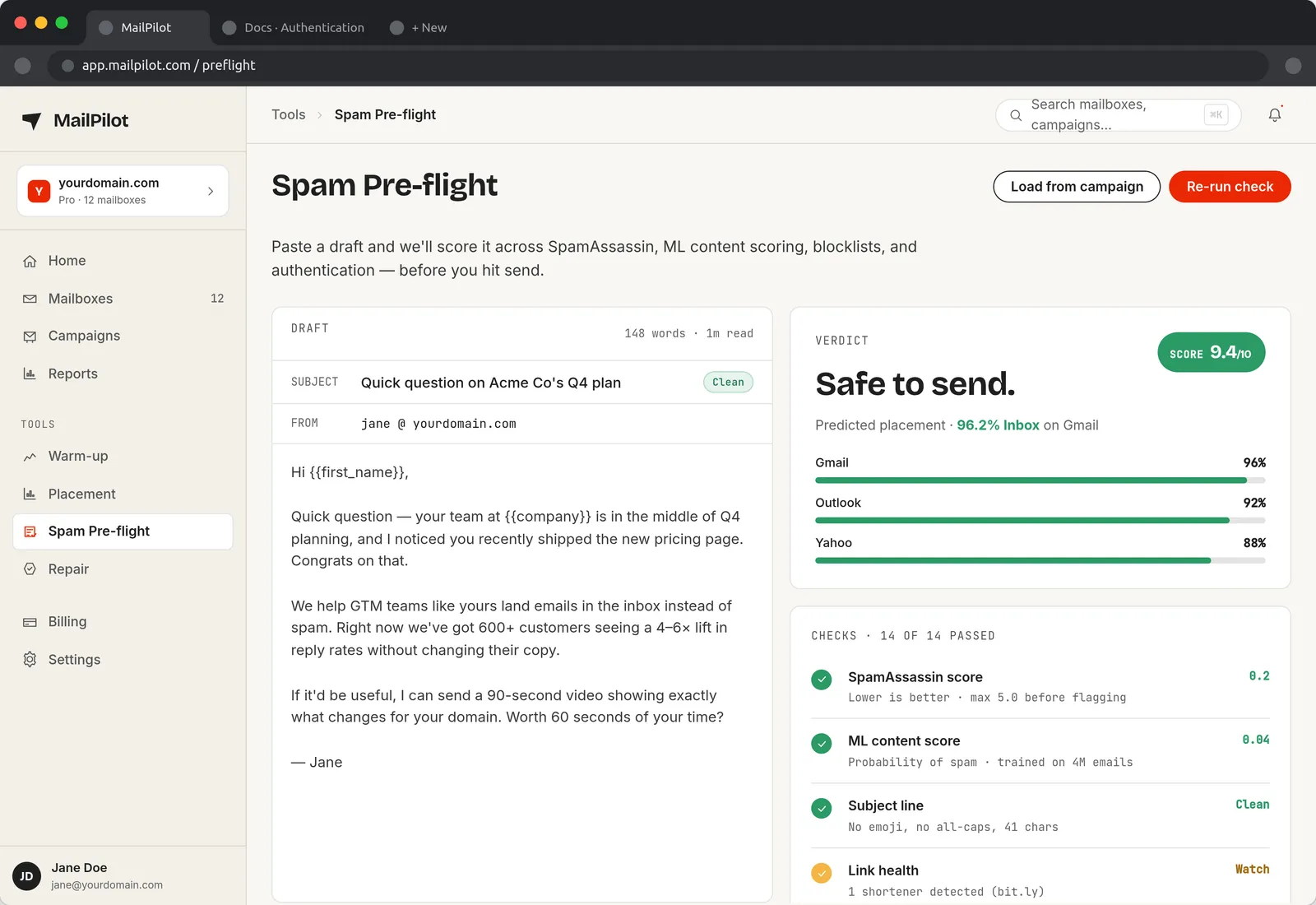
What the spam checker looks for
- Trigger words & phrases — “free”, “act now”, “guarantee”, “winner”, “100%”, etc.
- ALL-CAPS text — shouting reads as spam to filters and people alike.
- Excessive punctuation — multiple “!!!”, “$$$”, repeated symbols.
- Link density — too many links relative to text looks promotional.
- Thin / template-y body — ultra-short, link-heavy emails read as bulk.
Already bounced? A spam score explains the content, not the refusal — find your SMTP error to see what the server actually objected to.
A clean score isn't enough on its own
Even a perfectly-worded email lands in spam if the sender looks untrusted. The three things that decide placement alongside content are:
- Authentication — SPF, DKIM, and DMARC must pass. See the guide →
- Reputation — your domain/IP sending history and engagement.
- Warmup — a new or cold domain needs to build trust gradually before it can send at volume.
Fix the sender, not just the words
MailPilot warms up your mailbox across real inboxes and builds the reputation that gets you past spam filters — so your clean emails actually get seen.
Start free with MailPilotEmail spam checker — FAQ
How does the email spam checker work?
It analyzes your subject line and body for the signals spam filters weight most — trigger words and sales-y phrases, ALL-CAPS, excessive punctuation, too many links, and thin content — then returns a 0–100 spam-risk score (lower is better) with a specific fix for each issue. It runs entirely in your browser; nothing is sent to a server.
What is a good spam score?
Lower is better. On our 0–100 scale, under 15 is excellent, 15–35 is good, 35–60 needs work, and above 60 is high risk. A low content score doesn't guarantee inbox placement on its own — sender reputation and authentication (SPF/DKIM/DMARC) matter too — but a high score is one of the fastest ways to get filtered.
Why do my emails go to spam even with a good score?
Content is only one factor. Spam placement also depends on your domain and IP reputation, correct SPF/DKIM/DMARC authentication, engagement history, and whether your sending domain is warmed up. If your content is clean but mail still lands in spam, the cause is usually reputation or authentication — warming up the mailbox and fixing your DNS records is the fix.
Is the spam checker free and private?
Yes. It's completely free with no sign-up, and it's private by design — the analysis happens locally in your browser, so your email content never leaves your device or touches any server.